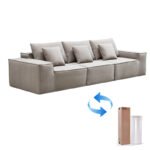
The traditional sofa industry is facing serious challenges—rising logistics costs, limited living spaces, inefficient packaging, and shifting consumer expectations. In 2025, compressed sofas are poised to disrupt the market by solving all these issues at once.
Compressed sofas will reshape the future of furniture with better logistics, smarter designs, and enhanced user experiences. They are not just a new product but a new standard.
As the founder of HSM Compress Sofa, I’ve witnessed first-hand how this innovative product transforms the way we think about manufacturing, selling, and using sofas. Below, I’ll break down the five key reasons why compressed sofas will dominate in 2025.
1. Are Compressed Sofas the Answer to Limited Living Space?

City apartments are getting smaller, but traditional sofas are not. Bulky, rigid, and hard to move—these old models no longer match modern lifestyles.
Compressed sofas reduce their volume by up to 70% during transport. This saves floor space for both sellers and customers.
In today’s global cities, floor space is expensive. Whether you live in downtown Toronto or Montreal, you know every square meter counts. A standard L-shaped sofa can easily take up 2–3 square meters, even during shipping. Compressed sofas flip that equation.
Why Space Efficiency Matters
-
Logistics: A 40-foot container that fits 90 traditional sofas can fit up to 220 compressed sofas
-
Retail Display: Offline furniture showrooms can store more styles and SKUs without expanding warehouse costs
-
Consumer Convenience: Customers in small apartments can store the sofa in a closet until they’re ready to set it up
Real-life Applications
-
College dorms and first apartments: The young generation moves frequently. A sofa they can carry, unpack, and install themselves is a game-changer
-
Vacation rentals and Airbnbs: Hosts can keep spares compressed and only expand when needed
-
Tiny homes and condos: The smaller your home, the more every inch of space matters
At HSM Compress Sofa, we work with global e-commerce sellers who target urban buyers. Space-saving design has become the number one sales driver in many of these markets.
2. Can Compressed Sofas Reduce Costs Across the Supply Chain?

Traditional sofas cost more to ship than to produce in many cases. That’s especially true for international e-commerce sellers who rely on container shipments and 3PL warehousing.
Compressed sofas reduce packaging, storage, and shipping costs by cutting total volume and weight, creating supply chain efficiency from factory to living room.
Let’s break it down with a comparison:
📦 Cost Comparison Table
| Category | Traditional Sofa | Compressed Sofa | Cost Savings |
|---|---|---|---|
| Shipping Volume | ~1.2–1.6 m³ per unit | ~0.4–0.6 m³ per unit | 60–70% reduction |
| Container Capacity | 60–90 units | 180–220 units | 2x–3x capacity |
| Warehouse Cost | High | Low | 50%+ saved |
| Handling Labor | Requires 2+ persons | Often 1 person | Less manpower |
| Return Logistics | Complicated & costly | Easy repack, lower cost | 30% cost down |
At HSM, we’ve built our factories around automation and compression. That’s why our clients from 100+ countries trust us—not only do they reduce their import fees, but also their final product cost.
We’ve helped sellers on Amazon, eBay, TikTok, and Alibaba save up to 40% on their supply chain costs, just by switching to our compressed sofa solutions.
3. Do Consumers Really Prefer “Unbox and Use” Sofas?

People want faster, simpler, and more flexible furniture options. They don’t want to wait days for delivery or pay extra for installation.
Compressed sofas offer a “plug-and-play” experience. No tools, no installation services, just unpack and sit.
From my own experience building HSM, one of the first things I noticed was how many customers hated the old sofa experience:
-
Delivery was slow
-
Assembly required help
-
Returns were a nightmare
Compressed sofas solve all of that
Why Consumers Love This
-
Quick Setup
Our sofas arrive in a compact box. You open it, let it decompress, and the foam + spring structure regains its shape in 24–48 hours -
Portable and Movable
You can move it in an elevator or carry it up narrow stairs. A huge win for people in apartments -
No Tools Required
There’s no need for screwdrivers, manuals, or multiple people. It’s as easy as opening a suitcase -
Easy Returns
If customers are unhappy (rare, but it happens), the sofa can be re-packed and sent back without hassle
This kind of user experience is already the new standard in mattresses. Just like how compressed foam mattresses took over the bedding industry, compressed sofas will do the same for living room furniture.
4. How Are Compressed Sofas Changing Furniture Design Itself?

Design is no longer about being big or bulky. In 2025, it’s about flexibility, modularity, and adaptability.
Compressed sofas allow modular design, which means users can customize layout, function, and even color—all while saving space.
Let’s look at how design is changing
Key Trends Enabled by Compression
-
Modular Units: Buyers can assemble different shapes—L-shaped, U-shaped, straight—based on living space
-
Convertible Functions: Sofas that double as beds, loungers, or even pet-friendly units
-
Flexible Assembly: Detachable arms, cushions, and covers
-
Compact Aesthetics: Slimmer profiles, minimalist lines, Nordic and Japandi styles
Examples from Our HSM Catalog
At HSM Compress Sofa, we design compressed models across different use cases
-
Corner Sofas for small family homes
-
Sofa Beds for guest rooms or rentals
-
1-Seater Armchairs perfect for balconies or reading corners
-
Sectional Sofas that fit both tiny condos and spacious homes
What makes our designs unique is that each piece looks like high-end furniture, but arrives in a compact box
5. Are Compressed Sofas Better for the Environment?
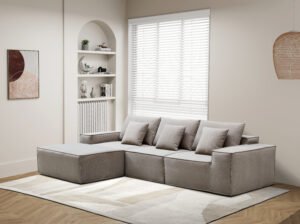
Sustainability isn’t just a trend—it’s a requirement. Customers, especially in North America and Europe, expect brands to do more with less.
Compressed sofas reduce carbon footprint by optimizing transportation and minimizing packaging waste, aligning with global sustainability goals.
Environmental Benefits
-
Less Packaging Material
Smaller boxes mean less cardboard, plastic, and filler -
Lower Emissions
Because one truck can carry 2–3x more sofas, there are fewer trips, meaning fewer emissions -
Lightweight Materials
We use high-resilience foam and recyclable fabrics—less weight, more efficiency -
Reduced Waste
Our packaging is 100% recyclable. Plus, the sofas themselves are designed to be long-lasting and modular, reducing the need for replacement
As a manufacturer, I believe it’s our responsibility to innovate not just for profit, but for the planet. That’s why we continuously develop eco-friendly compressed sofa solutions that meet ISO standards and reduce industrial waste
Conclusion
Compressed sofas are not just a new type of furniture—they’re a complete reinvention of how we design, ship, and enjoy sofas. In 2025, they will change the rules of the game with smarter supply chains, better user experiences, and sustainable practices.
If you’re in the furniture business or looking to scale with high-efficiency solutions, I invite you to explore more at https://compress-sofas.com